
“Reframing education beyond access”: In collaboration with Royal Docks Centre for Sustainability
On 15 June 2026, Abhyas, in collaboration with the Royal Docks Centre for Sustainability, convened the Education in a Changing World: From Access to Readiness Summit — a focused gathering designed to move the widening participation conversation beyond access and towards readiness, retention, belonging and workforce participation.
This summit marked an important milestone in the continued evolution of Abhyas: from its foundations in Mauritius to its growing presence in the United Kingdom, and from online experiential learning into live, cross-sector system activation.
The relationship between Abhyas and the University of East London began online through Abhyas’ flagship Well-Formed Mind Internship Programme, which began in 2025. The programme created a shared space for young people, educators and emerging professionals to explore awareness, self-understanding, emotional resilience, learning, leadership and conscious action.
What began as an online connection through the Well-Formed Mind Internship Programme grew into a deeper collaboration around a shared question:
How do we support young people not only to access education, but to remain engaged, build confidence, feel they belong, and participate meaningfully in society and the workforce?
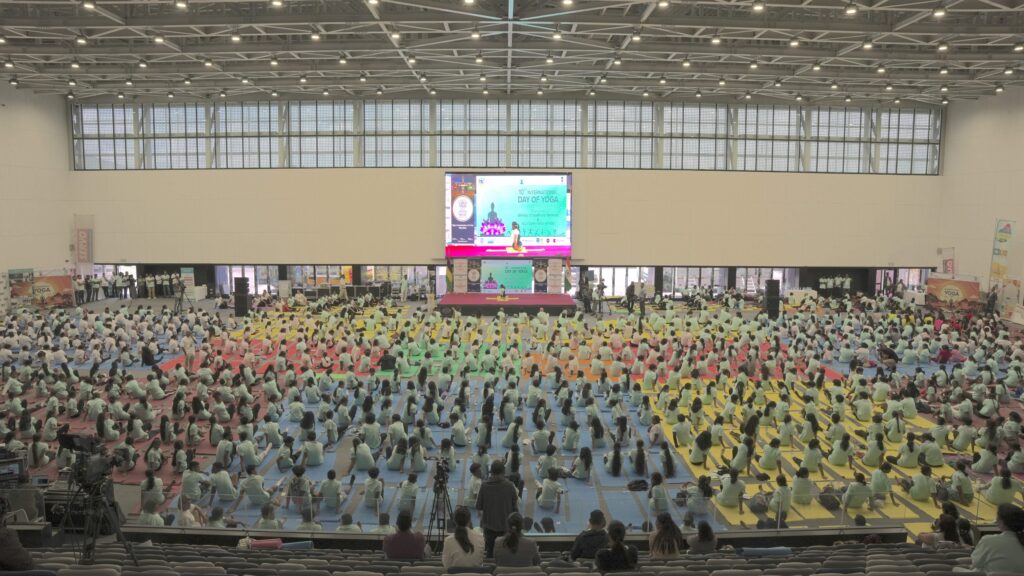
Every year, International Day of Yoga brings together schools, universities, healthcare institutions, wellness communities, workplaces, governments, and individuals from across the world. From sunrise yoga gatherings and public wellbeing events to digital participation campaigns and institutional initiatives, IDY has become one of the world’s largest collective wellness movements.
Yet the growing relevance of yoga today lies not merely in flexibility or physical fitness. Its deeper value is in helping individuals become more aware, emotionally resilient, and consciously connected to the way they live and respond to life.
Traditionally, yoga was never limited to movement alone. Its deeper essence includes awareness, discipline, balance, harmony, self-observation, and conscious living. As the world evolves, the meaning of yoga is also evolving — from being seen as a wellness trend to becoming a meaningful pathway toward inner stability and holistic wellbeing.

Integrate wellbeing into everyday living
Founded in Mauritius on the principle of experiential awareness, Abhyas believes that lasting change begins with a deeper understanding of oneself. As Abhyas expands its presence in the United Kingdom, we remain committed to advancing Human Sustainability through initiatives focused on wellbeing, workforce participation, leadership development, education, community engagement and preventative approaches to health and human development.
In a world experiencing rapid technological, social and economic transformation, Abhyas recognises the growing need to support not only professional capability, but also the human capacity required to adapt, thrive and contribute meaningfully to society.
Access is only the beginning
For many years, widening participation has rightly focused on opening doors. But access alone does not guarantee belonging, continuation, confidence or long-term success.
The summit invited participants to look beyond entry points and ask what happens after a young person enters the system.
- Do they feel they belong?
- Do they have the confidence to continue?
- Are they emotionally ready for transition?
- Are educators supported enough to guide them?
- Are institutions prepared for the hidden pressures affecting retention, progression and workforce participation?
The Abhyas framing was clear:
Access opens the door. Readiness determines whether students remain, engage, grow and flourish.
This is why the summit was not designed as a traditional conference. It was a system activation space — bringing together national policy insight, institutional reflection, lived experience, youth voice, educator wellbeing and experiential practice.
The purpose was not simply to discuss challenges. It was to identify practical pathways forward.
At the heart of the Abhyas contribution was a simple but powerful message:
If we want resilient young people, we must support the wellbeing, regulation and inner stability of the adults who guide them.
This reflects a core Abhyas principle: transformation is not only external. It begins with the way human beings observe themselves, regulate themselves and respond to life as it is.
Young people are not the problem — systems must change
The national urgency was brought into sharp focus by Rt Hon Sir Stephen Timms MP, who opened the summit with a keynote address.
Sir Stephen welcomed the initiative and recognised “the growing participation of the University of East London in public policy debates,” adding that he believed the University had “a great deal to contribute.”
He drew attention to Alan Milburn’s interim report on young people and work, and the rising number of young people who are not in employment, education or training — NEET — whose number has now passed one million after rising sharply from 2021 to 2024.
Quoting the report, Sir Stephen reminded attendees:
“The NEET rate has barely crept below 10% in 25 years. What should have been treated as an urgent national crisis has been absorbed into the background noise of public life. That tolerance is no longer acceptable.”
He also emphasised one of the most important points of the day:
“Young people are not to blame. Institutions that should have provided opportunities to them are the ones who have failed.”
This statement resonated deeply with the purpose of the summit. If young people are disengaging, dropping out, struggling with confidence, or becoming disconnected from education and work, the response cannot be blame. It must be responsibility, redesign and support.
Sir Stephen also spoke about disability employment, the Government’s investment in improved employment support, and the Connect to Work programme. He explained the importance of bringing together “Jobcentres, local councils, good charities, colleges and training providers and the NHS” to support those with “the most difficult and complex barriers to employment.”
He also referenced the Keep Britain Working agenda and Charlie Mayfield’s work with employers to establish “what a healthy workplace should look like.” Sir Stephen highlighted that too many people with disabilities, long-term health conditions or neurodiversity are still being lost from the workforce, not because they lack contribution, but because systems and workplaces do not always know how to support them.
For Abhyas, this reinforces a central principle: people do not flourish through systems that merely process them. They flourish through environments that see them, support them and help them build internal readiness.
Education is nation-building
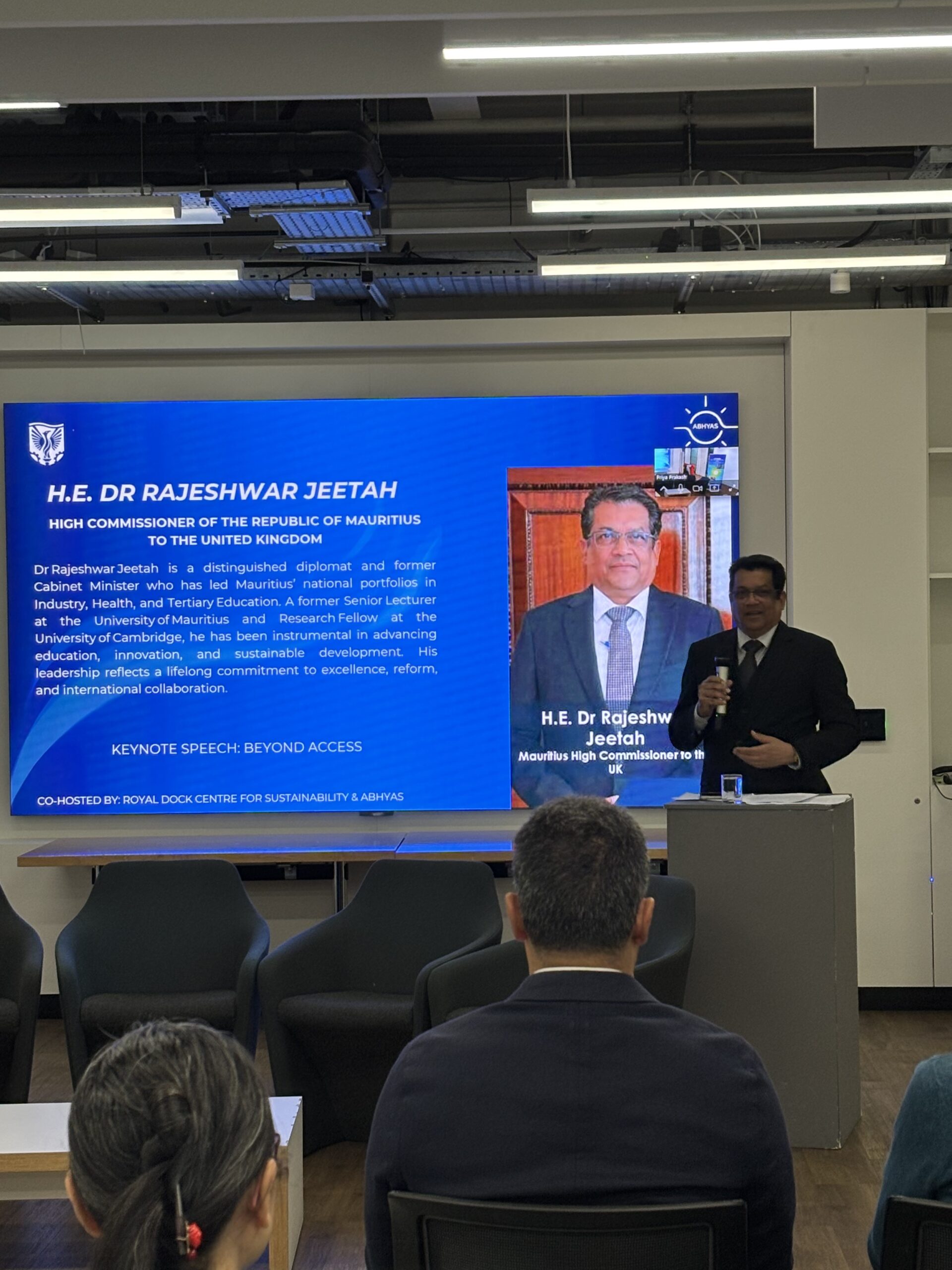
His Excellency Dr Rajeshwar Jeetah, High Commissioner of the Republic of Mauritius to the United Kingdom, brought a deeply personal and national perspective to the summit.
His reflections carried particular significance given Abhyas’ Mauritian roots and its growing presence in the UK.
His Excellency reflected on Mauritius’ journey from scarcity to national development. He described a time when even shoes were considered “a piece of exquisite material,” something one could be proud to have. He spoke of not being able to afford proper shoes to play football, and then asked the defining question:
“So how did we make it?”
His answer was education.
He explained that Mauritius’ founding fathers decided that “the key to success was education.” The country built schools, offered free education, and made education compulsory. He described how Mauritius moved from reliance on sugar into tourism, textiles and financial services, not by accident, but through policy, education, adaptation and the willingness to teach people new capabilities.
He spoke about how Mauritius had to teach people not only academic knowledge, but practical skills: how to sit in a factory, how to measure, how to understand inches and centimetres, the distance between buttons, and the details of production. This was not education in the abstract. This was education as economic transformation.
His Excellency also offered a powerful reflection on intelligence beyond formal schooling. He spoke about learning from an elderly man who had no formal education but had extraordinary skill in working with basalt rocks. Despite his own qualifications, His Excellency described being “in awe” of the man’s ability to understand how to break, place and shape stone.
His conclusion was profound:
“This is the difference between education and intelligence.”
He reminded the room that “no person is stupid” and that “everybody has his or her own strength.”
This message aligned strongly with the Abhyas philosophy. Human potential cannot be reduced to certificates, marks or job titles. Each person carries inner capacity, lived intelligence and latent strength. The role of education is not only to instruct, but to recognise, cultivate and bring that strength forward.
As Abhyas reminds us, the learning which comes from people is sacrosanct. Formal teaching remains subservient to the learning of life.
Education must teach what AI cannot
The panel discussion explored a central question:
What is education at its core?
The responses moved the conversation far beyond curriculum and qualifications.
Louise Harries of MSDUK reflected on education through the analogy of learning to drive. Knowledge matters, skills matter, but confidence is what allows someone to move independently. She spoke about helping young people understand “who they are and why they matter,” and why belonging is essential if young people are not to become disenchanted with life.
She also shared powerful examples of mentoring and advocacy. One young man with a master’s degree in data science was working in Tesco, unable to secure a role in tech despite having strong ability. Through one-to-one mentoring, interview practice and advocacy, he eventually secured work on a data science project. Her message was clear: sometimes talent is present, but confidence, communication, opportunity and the right support are missing.
Anand Mistry of ProjectCHAKRA made an important distinction between learning and education. He described learning as an “infinite game” that continues throughout life, while education is often the structured and finite part of that journey.
He used the “Mary’s Room” thought experiment to illustrate that information alone is not enough. Mary may know everything about colour intellectually, but until she experiences colour, something is still missing. Anand connected this to education today, arguing that learners need more than content. They need experience.
His language of connecting the head, heart and hands strongly echoed the Abhyas approach: knowledge, feeling and application must come together. Learning must be lived, not merely consumed.
Daniel Mullings of Techembrace explored how AI can support personalisation, accessibility and problem-solving when used responsibly. Drawing on his experience with technology, AI and neurodiversity, he argued that young people should not simply be kept away from AI. Instead, they must be taught to use it ethically, legally and purposefully.
He reminded participants that technology can help people express needs, personalise learning and create new pathways, but only when it is used with responsibility and care.
Louisa Hendrickson of Zion’s Lighthouse brought the conversation back to humanity. She reminded the room that AI can provide information, but it cannot teach the human lessons that shape character.
She said AI cannot teach emotional regulation, resilience, how to sit with discomfort, or how to deal with grief, trauma and disappointment. It cannot teach what love feels like, what joy feels like, or what sadness feels like.
Her message captured one of the strongest themes of the summit:
The educator’s responsibility is to teach humanity.
Dr Alireza Monajati of the University of East London highlighted the importance of soft skills alongside specialist knowledge. He explained that young people may acquire technical or academic knowledge, but without confidence, emotional intelligence, communication, digital capability and belonging, they may struggle to apply that knowledge in the real world.
He also warned that while AI can support access to information, it may reduce opportunities for trial and error, creativity, social development and problem-solving if education systems do not adapt.
Across the panel, one message came through clearly:
Young people do not only need access to knowledge. They need environments that help them build confidence, curiosity, emotional strength, communication, belonging and the ability to apply learning in real-world contexts.
For Abhyas, this is the work of forming the whole person.
A well-formed mind is not simply full of information. It is able to observe, regulate, reflect and respond consciously.
Young people must be in the room
The summit also heard from young leaders and changemakers, including members of the Ben Salmi family, who brought a vital intergenerational perspective to the discussion.
Their reflections highlighted the importance of financial literacy, youth leadership, entrepreneurship, curiosity and access to rooms where decisions are made.
One of the strongest messages was that young people are too often discussed in rooms where they are not present. Decisions are made about their futures, but without their voices. The speakers challenged this directly and argued that young people must be invited into conversations, institutions and leadership spaces much earlier.
They also spoke about curiosity. Young people are not necessarily lacking ambition; many are lacking exposure, opportunity, networks and confidence. They need to see what is possible before they can imagine themselves within it.
This echoed a central question of the summit:
Are we telling young people what they should become, or are we helping them discover who they are?
At Abhyas, this distinction matters. Conscious action cannot be imposed from outside. It begins with awareness, self-understanding and the ability to see one’s own place in the world.
Educator wellbeing is not an add-on — it is behavioural infrastructure
After a morning of discussion, Abhyas moved the summit from intellectual understanding into direct experience.
The Abhyas experiential session invited participants to pause, stand, move, sit, breathe and observe. Through guided breathwork and nervous system grounding, participants were introduced to the practical foundations of self-regulation.
Abhyas reminded the room:
“Happiness or distress, loss or gain, victory or defeat — just breathe as if breath is the greatest capital bestowed upon you. Receive your breath.”
The purpose of the session was not simply relaxation. It was to demonstrate how regulation begins in the body, how awareness begins with breath, and how educators can only hold space for others when they are also supported to hold themselves.
Participants were invited to experience the breath as a tool for presence. The breath “knows no future” and “knows no past”; it brings attention back to what is here now. In that moment, the summit shifted from discussion to lived experience.
This is the foundation of the Abhyas Educator Wellbeing approach.
Educators are not merely teachers of information. They are mentors, facilitators, emotional anchors, role models and retention drivers. Their state influences the learning environment. Their regulation affects student regulation. Their wellbeing shapes belonging, engagement and progression.
A regulated educator creates a regulated learning environment.
At Abhyas, we recognise that true wellbeing extends beyond our perceived views of stress or pressure. It is the ability to engage with life consciously, respond rather than react, and develop the resilience needed to meet life’s challenges as they are.
The summit reminded us that there shall not be any other more important goal than evolving yourself with each situation of your life. In education, this means helping both educators and students develop the capacity to meet complexity consciously — not by withdrawing, reacting or becoming overwhelmed, but by learning how to remain present, regulated and responsive.
The 21-Day Abhyas Educator Wellbeing & Transition Readiness Programme
The summit introduced the 21-Day Abhyas Educator Wellbeing & Transition Readiness Programme, designed to support educators with self-awareness, emotional regulation, stress resilience, reflective practice, conscious lifestyle choices and collective growth.
The programme is grounded in the belief that educator wellbeing is not a wellbeing add-on. It is behavioural infrastructure.
If systems want stronger student retention, better progression, improved workforce readiness and more inclusive learning environments, then the adults within those systems must also be supported mentally, emotionally and professionally.
The Abhyas programme supports educators to become more self-regulated practitioners and mentors, capable of creating stable, attentive and resilient learning environments for students navigating increasingly complex pressures.
It reflects the wider Abhyas commitment to creating opportunities for individuals to cultivate greater attentiveness, self-understanding and inner balance, while contributing to healthier workplaces, stronger communities and a more sustainable society.
Why Part 2 matters
Part 1 opened the conversation. Part 2 is designed to go deeper.
The next summit, Beyond Access: Transition Readiness, Retention & Workforce Participation, will focus on the hidden factors that determine whether young people stay engaged, progress through education, and move into meaningful participation in society and the workforce.
Part 2 matters because the challenge is not only getting young people into education. It is understanding what happens next.
Do they feel they belong?
Do they have the confidence to continue?
Are educators supported enough to guide them?
Are institutions equipped to prevent disengagement before it becomes dropout?
Are employers, councils, charities, trusts, foundations and education leaders working together early enough to prevent young people from becoming NEET?
This follow-up summit is for those who want to move from conversation to practical action. It will bring together education leaders, policymakers, employers, councils, researchers, civic society, trusts, foundations and workforce stakeholders to explore implementable solutions around transition readiness, retention, educator wellbeing, NEET prevention and workforce participation.
Participants should join Part 2 if they care about preventing young people from becoming disconnected from education, employment or training; improving student retention, belonging and progression; supporting educators as mentors, emotional anchors and retention drivers; building more inclusive education-to-work pathways; and strengthening cross-sector collaboration between education, employers, councils and communities.
The conversation must now evolve from what we know to what we do.
From access to readiness
The summit closed with a shared understanding that widening participation must now evolve.
The next frontier is not simply helping students get in.
It is helping them stay.
It is helping them belong.
It is helping them build confidence, resilience and readiness.
It is helping them participate fully in education, employment and society.
This is the movement from access to readiness.
With Abhyas now building meaningful partnerships in the United Kingdom, we look forward to working with educational institutions, employers, community organisations, researchers and changemakers who share a commitment to human development and positive social impact.
Abhyas is proud to have helped shape and deliver this important summit in collaboration with the University of East London and the Royal Docks Centre for Sustainability. The event created space for policy, research, lived experience, employer insight, youth voice and embodied practice to come together around one shared purpose: building education systems that support human beings, not just academic pathways.
As Abhyas reminds us:
Growth is a quiet, relentless, personal event — it never demands applause.
But when growth is consciously supported, it can transform individuals, institutions and society.
Join Part 2: Beyond Access
The conversation continues at:
Beyond Access: Transition Readiness, Retention & Workforce Participation
ABHYAS-RDCS UEL Widening Participation Summit 2026 – Part 2
This follow-up summit will explore the hidden factors shaping student success, educator wellbeing, retention, transition readiness and workforce participation.
Share:
Table of Contents
More Posts
We Are All Set for the 12th International Day of Yoga
# International Day of Yoga 2026:

Nirvisha: You Are a Reservoir. It’s Time to Empty
“Before we reach for supplements, superfoods, or detox drinks — our ancestors had already figured it out. Every morning, before food, before screens, before the world got loud — they had a ritual.”
Mental Well-being for All
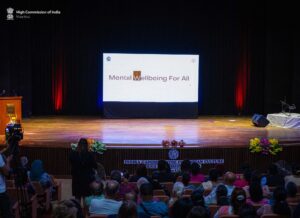
Mauritius witnessed a landmark gathering on mental health, organized by the Abhyas Institute of Universal Awareness in collaboration with the Indira Gandhi Centre for Indian Culture (IGCIC – ICCR in Mauritius). Held in observance of World Mental Health Day and aligned with the United Nations 2025 theme — “Access to Services: Mental Health in Catastrophes and Emergencies” — the “Mental Well-Being for All” Conference brought together policymakers, thought leaders, educators, spiritual guides, healthcare professionals, youth, and civil society to champion holistic mental well-being and explore practical strategies for building a resilient society.
Creating a Harmonious Workplace: A much needed forum
The First Forum on Harmony, Wellbeing, and Conscious Leadership in Mauritius In a time of fast-paced change, high pressure, and digital transformation, the idea of